
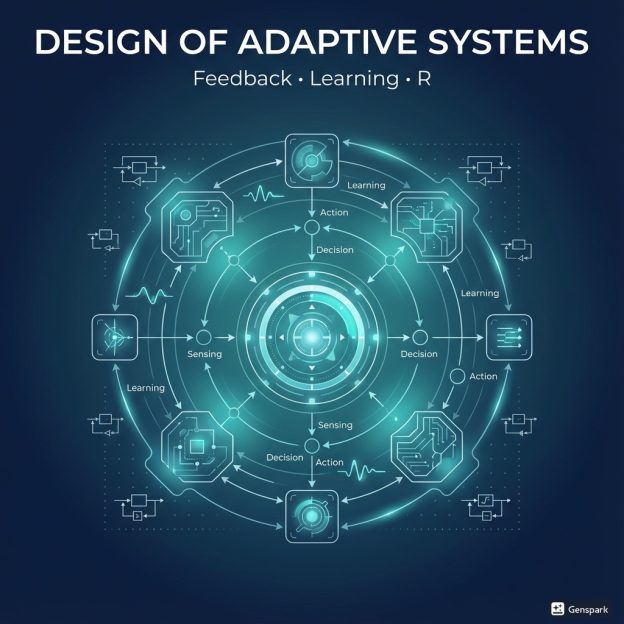
Design of Adaptive Systems

In the study course, students are presented with the necessary knowledge for designing adaptive systems, including: the concept of adaptive systems, development process throughout the life cycle of adaptive systems, and examples of systems and their design. Students perform an individual task – designing. Examples of system adaptation, improvement of their quality indicators, stabilityconditions, analog and numerical modeling are studied. The study course is adapted to the methodology of combined studies and includes asynchronous and synchronous study activities, as well as the necessary support materials for asynchronous study activities. Advanced computing
methods will be used to solve systems of differential equations, to calculate parameters studied in laboratory work. Examples of system parameter calculations and process modeling with MatLab software are considered. During the study course, students use a high-performance computing platform to calculate parameters of practical systems, solve differential equations and characteristic equations using the MatLab programme. Laboratory works are provided in MatLab by logging to the HPC resources of virtual machines. During the study course, students use a high-performance platform for complex calculations and calculation of parameters of adaptive systems.
Students learn the highest-level digital skills corresponding to the Digital Competence Framework for European Citizens (DigComp).
Goals and objectives of the course in terms of competences and skills
The goal of the study course is to promote students’ understanding of modern high-performance computing technologies and their use for designing adaptive systems, and to develop skills in performing computer calculations for determining the parameters of complex adaptive systems in electrical engineering systems and industrial processes.
Tasks of the study course:
– to teach to understand the structure of the autonomous regulation system, use adaptation;
– to develop students’ skills in using high-performance computing technology for modeling the working modes of autonomous systems;
– to develop students’ skills in using digital tools for calculating the parameters of optimal operating modes of adaptive systems;
– to teach to understand the application of schemes and design principles;
– to teach how to practically analyse and evaluate operating modes and their quality.
You must log in and have started this course to submit a review.
Course Content
Section 1
About Instructor

Course Includes
- 14 Lessons
- 1 Topic
- 12 Quizzes