

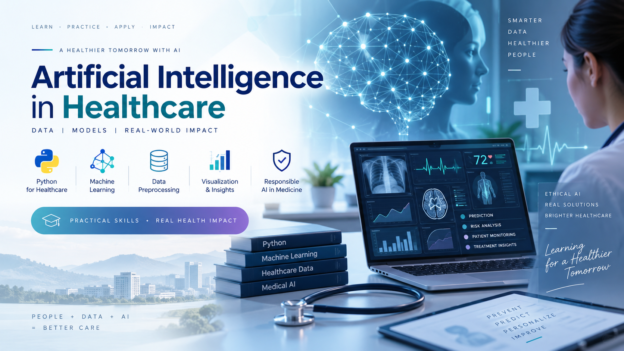
Artificial intelligence is becoming an important part of modern healthcare. It is used to support medical data analysis, patient monitoring, risk prediction, image processing, decision support, and many other healthcare-related tasks. At the same time, healthcare data is often complex, noisy, sensitive, and difficult to interpret without proper analytical methods.
This course introduces practical approaches to working with healthcare-related data using Python and artificial intelligence methods. The focus is not only on theory, but also on hands-on work with datasets, code, data preprocessing, visualisation, and model results interpretation.
During the course, students will complete practical tasks in Google Colab/Jupyter notebooks. Each practical work includes a dataset, code examples, small TODO tasks, and an automatically graded quiz. Students are expected to run the notebook, complete the missing parts, analyse the results, and answer quiz questions based on their outputs.
The course is designed for students who want to understand how artificial intelligence methods can be applied to healthcare data analysis in a practical and responsible way.
Course Goals
The goal of this course is to help students understand and apply basic artificial intelligence and data analysis methods in the healthcare domain.
In this course, students will learn how to:
- work with healthcare-related datasets;
- load, clean, and explore data using Python;
- identify missing, incorrect, or unusual values;
- visualise data and interpret simple patterns;
- analyse relationships between variables;
- prepare data for machine learning tasks;
- apply basic AI and machine learning methods;
- evaluate results and understand model limitations;
- use Google Colab/Jupyter notebooks for practical data analysis.
Course Outcome
After completing this course, students will be able to perform basic healthcare data analysis using Python and understand how artificial intelligence methods can support healthcare-related decision-making.
Students will also be able to interpret analytical results critically and understand that AI models in healthcare should be used as support tools, not as replacements for medical professionals or clinical judgement.
Course Format
The course is based on practical assignments.
Each practical work includes:
- a short task description;
- a Google Colab/Jupyter notebook;
- a dataset file;
- code examples with TODO blocks;
- an automatically graded quiz.
Students should complete the notebook tasks first and then answer the quiz questions based on the results obtained in the notebook.
Assessment
The assessment is based on automatically graded quizzes after each practical work.
Quiz questions may include:
- single choice questions;
- multiple choice questions;
- interpretation of code outputs;
- interpretation of charts, statistics, and model results.
The quizzes are designed to check not only whether students can run the code, but also whether they understand the results.
About Instructor

Course Includes
- 8 Lessons
- 11 Topics
- 8 Quizzes